
Review · CHINATOWN SINGAPORE TOURS
Singapore’s Historic Chinatown Walking Tour with Lunch
Chinatown’s story comes into focus on foot: one minute you’re looking down on the old district from CapitaSpring’s Sky Garden, and soon after you’re standing in a temple founded in the early 19th century. This 3.5-hour walk links landmarks with the back streets and working shops that are easy to miss on your own.
I like two things in particular: the route ties history to real places, from a former boys’ school courtyard to the so-called Street of the Dead, and lunch is part of the day, not an afterthought. You’ll also stop for snacks at long-running local businesses, so the food is woven into the neighborhood story.
The trade-off is pace. Nineteen stops in three and a half hours means plenty to see, but not long at every place. If you like taking photos or lingering in temples, you may need to choose between keeping up with the group and pausing for your own look.
What makes this Chinatown walk worthwhile
- A rooftop view sets the scene: Start at CapitaSpring’s Sky Garden for a bird’s-eye view over the Historic District.
- Temples anchor the timeline: Visit Yueh Hai Ching Temple and Thian Hock Keng Temple, with time to look at their architecture and learn about their place in Singapore’s early Chinese community.
- The side streets hold the stories: Ann Siang Hill, Club Street, Mohamed Ali Lane and Sago Street add everyday details that a landmark-only walk could miss.
- Food comes with context: Lunch is traditional soya sauce chicken rice or noodles at Chiew Kee Noodle House, an establishment dating to 1949.
- Small group, substantial route: The group is capped at 15, and the walk lasts about three and a half hours. Expect a steady outing rather than a gentle stroll.
A city view before the street-level stories
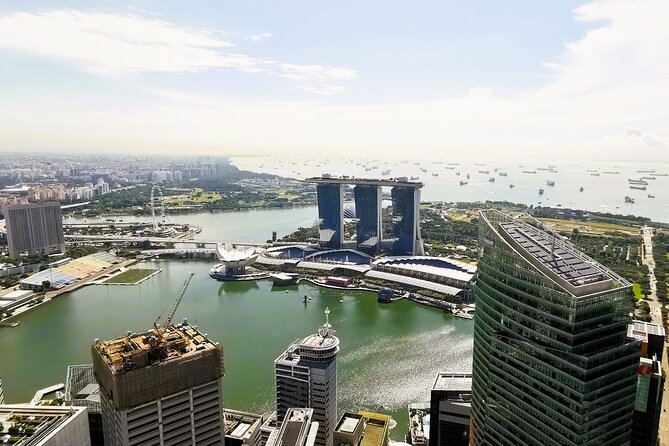
The tour begins at The Whisky Distillery, at 1 Raffles Place, and starts at 10:00 am. Its first stop is the Sky Garden at CapitaSpring, Singapore’s second-tallest skyscraper. From up high, the Historic District becomes a map: the compact streets below are easier to place once you’ve seen how Chinatown fits into the city.
The stop lasts about 20 minutes, and admission is included. This is a useful opening because the rest of the tour is about details at street level. After the broad view, you’ll walk into the district and begin linking its streets, buildings and institutions to the people who shaped them.
More Chinatown tours around Singapore:
- Chinatown, Little India, Kampong Gelam City Highlights Tour
★ 5.0 · 224 reviews - Singapore: Chinatown Hawker Market Food Tour with 7 Food Tastings
★ 5.0 · 213 reviews - Singapore: Chinatown and Little India Guided Walking Tour
★ 4.8 · 190 reviews
Temples that tell different parts of the story
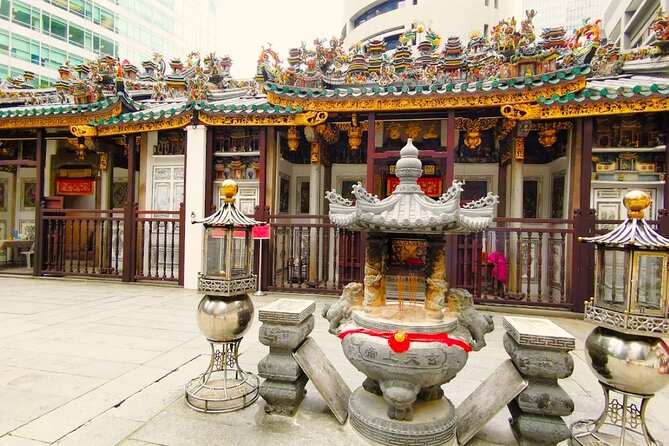
At Yueh Hai Ching Temple, the guide introduces a site that may date as far back as 1819. It is often overlooked, which makes this a good early stop for seeing a quieter side of Chinatown. You’ll have about 15 minutes inside, enough to take in the calm atmosphere and hear why its age matters.
The next stops shift from worship to education and community life. On Pekin Street, you step into the courtyard of a Chinese boys’ school established in 1854. The guide asks you to picture schoolboys learning to read and write, then playing chapteh after class. It’s a small stop, around 10 minutes, but it helps turn an old courtyard into a place with daily life behind it.
At Fuk Tak Chi Museum, a modest former temple built by Cantonese and Hakka worshippers in the 1820s now presents objects and scenes connected to local life. The visit lasts about 10 minutes. Rather than treating the building as just another old façade, you get a sense of how a place of worship also served a community of early migrants.
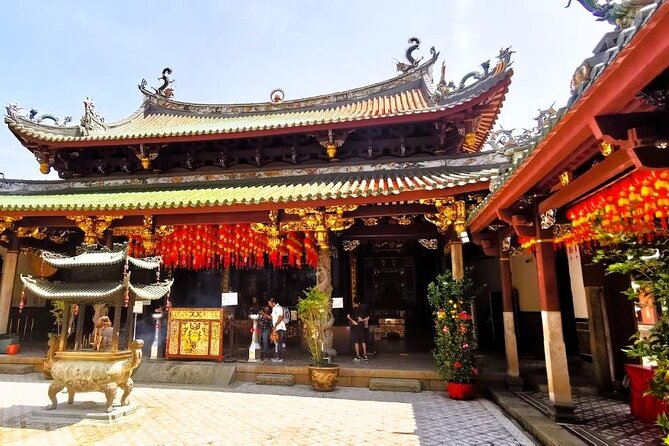
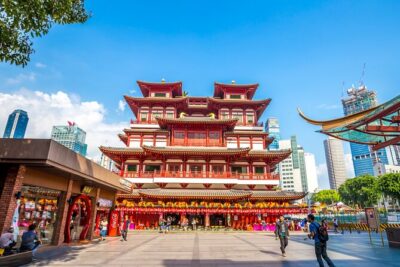
Thian Hock Keng Temple receives a longer visit, about 25 minutes. Established in 1821, it is the oldest Hokkien temple in Singapore and likely the second-oldest Chinese temple in the country. Its construction is notable for using no nails. This is one of the main architectural stops, and the extra time gives the guide room to explain more than the building’s age and appearance.
Hills, clubs and Chinatown’s social life
The route then moves to Ann Siang Hill, where you’ll hear about the hills and plantations that once occupied this area and how the hill got its name. The stop also includes a search for Chinatown’s last water well. At about 10 minutes, it’s a quick lesson in how much the district’s terrain and uses have changed.
Club Street adds a different kind of history. At the Chinese Weekly Entertainment Club, the guide explains the story behind the street’s name and the high-society parties held at the millionaire’s club. The stop is only five minutes, followed by a two-minute pause at Goh Loo Club to hear about another wealthy Chinese club and its distinctive window grilles.
These short visits are part of the tour’s strength and its limitation. They connect buildings to social life and local status, but you won’t have time to study every façade or linger at every corner. I’d treat them as story stops: listen, look closely, and save a longer return visit for anything that catches your eye.
Murals, lunch and shops that have lasted
At Mohamed Ali Lane, you’ll see a mural by local artist Yip Yew Chong. His heritage-themed street art appears at several points along the route, offering visual scenes of old Chinatown alongside the physical buildings. The stop is brief, around two minutes, so have your camera ready if you want a photo.
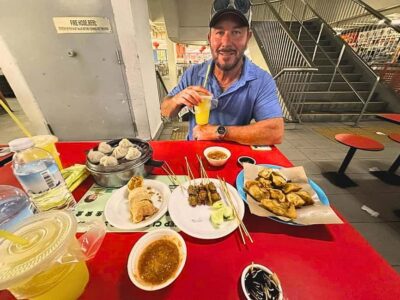
Then comes lunch at Chiew Kee Noodle House, which dates to 1949. The included meal is traditional soya sauce chicken served with rice or noodles, and the stop lasts about 30 minutes. Snacks are included too, though the specific snacks are not set out in advance. The value here is practical as well as cultural: you don’t need to break off the walk to find lunch, and the meal gives the group time to sit and refuel.
After lunch, Yue Hwa Chinese Products provides a look at a 1927 building once known as the Raffles Hotel of Chinatown. It now houses a Chinese emporium. The stop is only about two minutes, so think of it as a quick introduction to the building’s earlier role rather than a shopping visit.
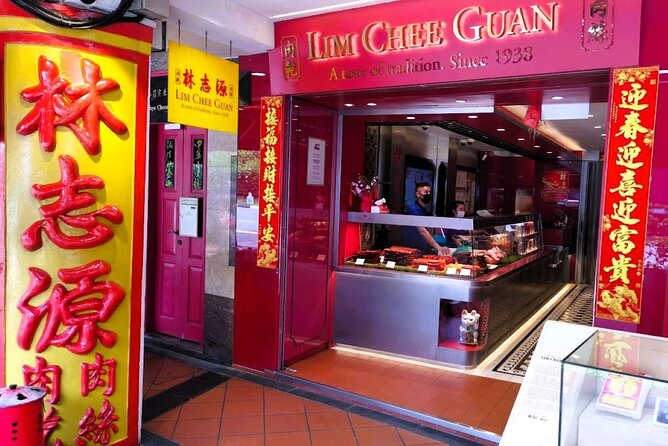
The Majestic is another brief architectural story. You’ll hear how the theatre came into being and about the wealthy Chinese merchant who made it possible. The route then pauses for about 10 minutes at Lim Chee Guan, a Singapore brand established in 1938 that endured the Second World War. These stops show how commercial buildings and businesses can carry a long memory, even as the neighborhood changes around them.
Pek Sin Choon, a tea shop founded in 1925, is known for its Nanyang blends. You’ll have about 10 minutes there. At Tai Thong Cake Shop, established in 1950, the focus shifts to Cantonese-style mooncakes and other sweets sold year-round, with a taste included in the visit. These are good stops for anyone who likes food history as much as temple architecture.
At Lau Choy Seng, a kitchenware shop dating to 1948, you’ll find shelves of cooking equipment and another chance to see how old businesses remain part of the district’s daily commerce. The visit lasts about 15 minutes. The nearby Temple Street area also has three more Yip Yew Chong murals, adding a visual thread to the walk.
More walking tours around Singapore:
- Singapore: Private Walking Tour with a Local
★ 4.7 · 410 reviews - Private Customised Singapore Walking Tour
★ 5.0 · 370 reviews - Singapore: Customized Private Tours (Car/Bus/Walking)
★ 5.0 · 181 reviews - Eat Snap Katong Walking Food Tour
★ 5.0 · 174 reviews
Sago Street and the final stop
Smith Street brings another mural by Yip Yew Chong, this one depicting his own home in Sago Lane more than five decades ago. You’ll also look at Lai Chun Yuen Opera House. The stop lasts about 15 minutes, one of the longer opportunities to take in a street scene and hear how entertainment fitted into Chinatown’s past.
Sago Street, once known as the Street of the Dead, is the next stop. The guide explains how it earned that name and what the area has become today. This five-minute visit adds a sobering note to the walk, showing that Chinatown’s history includes difficult parts of life as well as temples, shops and food.
The tour ends at Fong Moon Kee, an ointment shop established in 1908. The guide connects its remedies to the aches and pains of coolies and rickshaw pullers who once worked in the district. You’ll have around 10 minutes at the shop, and the endpoint is 16 Sago Street.
How much walking, and what the pace feels like
This is a walking tour with 19 stops, not a bus tour with a few short strolls. The total duration is about three and a half hours, and one account of the route put the walk at roughly 8,000 steps. That gives you a sense of the physical effort, though your own step count will vary.
The group maximum is 15. A smaller group can make it easier to hear the guide and ask questions, but there’s still a lot of ground to cover. One useful tip is to keep your camera ready before the brief two-minute stops, and save longer photo sessions for the temple visits or other pauses with more time.
The guide is central to the experience because so many stops are brief. Ping has led the tour, and her approach is described as cheerful and open to questions, with particular strength in Singapore’s social history. If your departure is led by Ping, expect stories that connect the sites to customs and daily life, not just dates and names. The specific guide may vary.
Price, inclusions and who should book
At $55.51 per person, the price covers a licensed tourist guide, snacks, lunch and a disposable poncho in case of rain. The value is strongest if you want one guided route that combines temples, murals, old businesses and food without arranging each stop yourself. You’re paying for interpretation as much as for the meal.
The tour is booked, on average, about 35 days ahead, but that is not a rule: one departure had space for a booking made less than 24 hours in advance. If you have a particular date in mind, booking ahead is sensible. Gratuities are not included.
This suits first-time visitors who want a grounded introduction to Chinatown, history-minded walkers, and anyone who prefers local streets and stories to a checklist of big sights. It is also a good fit if you like learning through food and architecture. You may find it less appealing if you want a slow, unstructured morning, long visits at every temple, or lots of time for shopping.
The start is near public transportation, and the tour ends at Fong Moon Kee on Sago Street. Most people can participate. Free cancellation is available up to 24 hours before the start time; changes or cancellations made later are not accepted for a refund.
Should you book this Chinatown walk?
I’d book it if you want a well-filled morning that makes Chinatown’s details easier to read. The combination of temples, club buildings, murals, food shops and a sit-down lunch gives the area more dimension than a quick self-guided loop, and the group limit keeps the outing from becoming a crowd.
Go in expecting a brisk pace. You’ll see many places, but some are short stops rather than extended visits. If you’re happy to keep moving, ask questions and return on your own to a favorite temple or shop afterward, this is a useful and satisfying way to understand Historic Chinatown.
FAQ
How long is the Singapore Chinatown walking tour?
The tour lasts approximately three hours and 30 minutes.
What time does the tour start?
The listed start time is 10:00 am.
Where does the tour begin?
It begins at The Whisky Distillery, 1 Raffles Place, #01-07/08, Singapore 048616.
Where does the tour end?
It ends at Fong Moon Kee, 16 Sago Street, Singapore 059016.
Is lunch included?
Yes. Lunch is traditional soya sauce chicken served with rice or noodles at Chiew Kee Noodle House. Snacks are also included.
What is the tour price?
The listed price is $55.51 per person.
How large is the group?
The maximum group size is 15 people.
Is a guide included?
Yes. The tour includes a licensed tourist guide. Ping has led the walk, though the guide may vary by departure.
Is a poncho provided if it rains?
Yes. A disposable poncho is included in the event of rain.
More Lunch Experiences in Singapore
- Singapore: Chinatown Historic Walking Tour with Lunch
★ 5.0 · 134 reviews - Splendour of Colonial Singapore Walking Tour with Lunch
★ 5.0 · 82 reviews - Splendour of Colonial Singapore Walking Tour with Lunch
★ 5.0 · 59 reviews - SMALL GROUP: Batam day tour with Ferry, 1-hour Massage, and Lunch from Singapore
★ 4.0 · 29 reviews
Just added around Singapore
- Singapore Changi Airport Arrival Transfer★ 5.0 · 13 reviews
- Singapore Changi Airport (SIN) to Singapore – Arrival Private Transfer★ 5.0 · 6 reviews
- Singapore City Bike Tour★ 5.0 · 14 reviews
- Singapore Airport: Shared Arrival or Departure Car Transfer★ 3.5 · 3 reviews
- Singapore Private & Personalized Half-Day Tour with a Local Guide★ 5.0 · 18 reviews
- Skip the Line: Singapore Cable Car Sky Pass (Round-Trip)★ 4.0 · 11 reviews
- Private Customized Walking Tour with English Tour Guide★ 5.0 · 5 reviews
- Sentosa Island Escapade with Roundtrip Transfers★ 4.0 · 8 reviews
Chinatown Singapore Tours, compared.
Chinatown, Little India, Kampong Gelam City Highlights Tour
Read our review →
Chinatown Hawker Market Food Tour with 7 Food Tastings
Read our review →
Kampong Glam, Little India & Chinatown with Local Street Food Tastings
Read our review →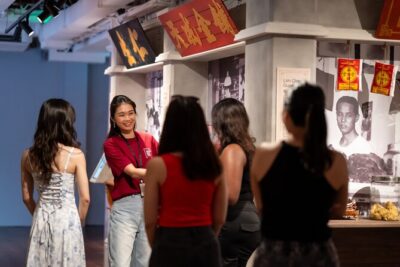
Tasting Trails: Chinatown OR with Kampong Glam, Little India
Read our review →Browse the lists this tour appears in